
The 20 hours night driving NSW learners must log is the part of the log book most families leave until last, and that is a mistake. As a paramedic, I attended far too many crashes at night: fatigue, glare, speed that suited daylight but not darkness. Night driving is a different skill, and 20 hours is the minimum, not the target. Planned well, those hours make you a much safer driver.
Key takeaways
- The 20 hours night driving NSW learners under 25 must log is driven between sunset and sunrise, as part of 120 hours.
- Bonus hours from a night lesson count only as daytime hours, so most night hours come from supervised drives.
- Dip high beam within 200m of oncoming vehicles and vehicles ahead, and look to the left if dazzled.
- Fatigue is a bigger risk at night. About 17 hours awake affects driving like a BAC of 0.05.
In this guide I explain what counts as a night hour, how to plan your 20 hours, the NSW rules for headlights and high beam, how to deal with glare, and the hazards that are worse at night: fatigue, pedestrians and wildlife.
What counts as night driving in your log book?
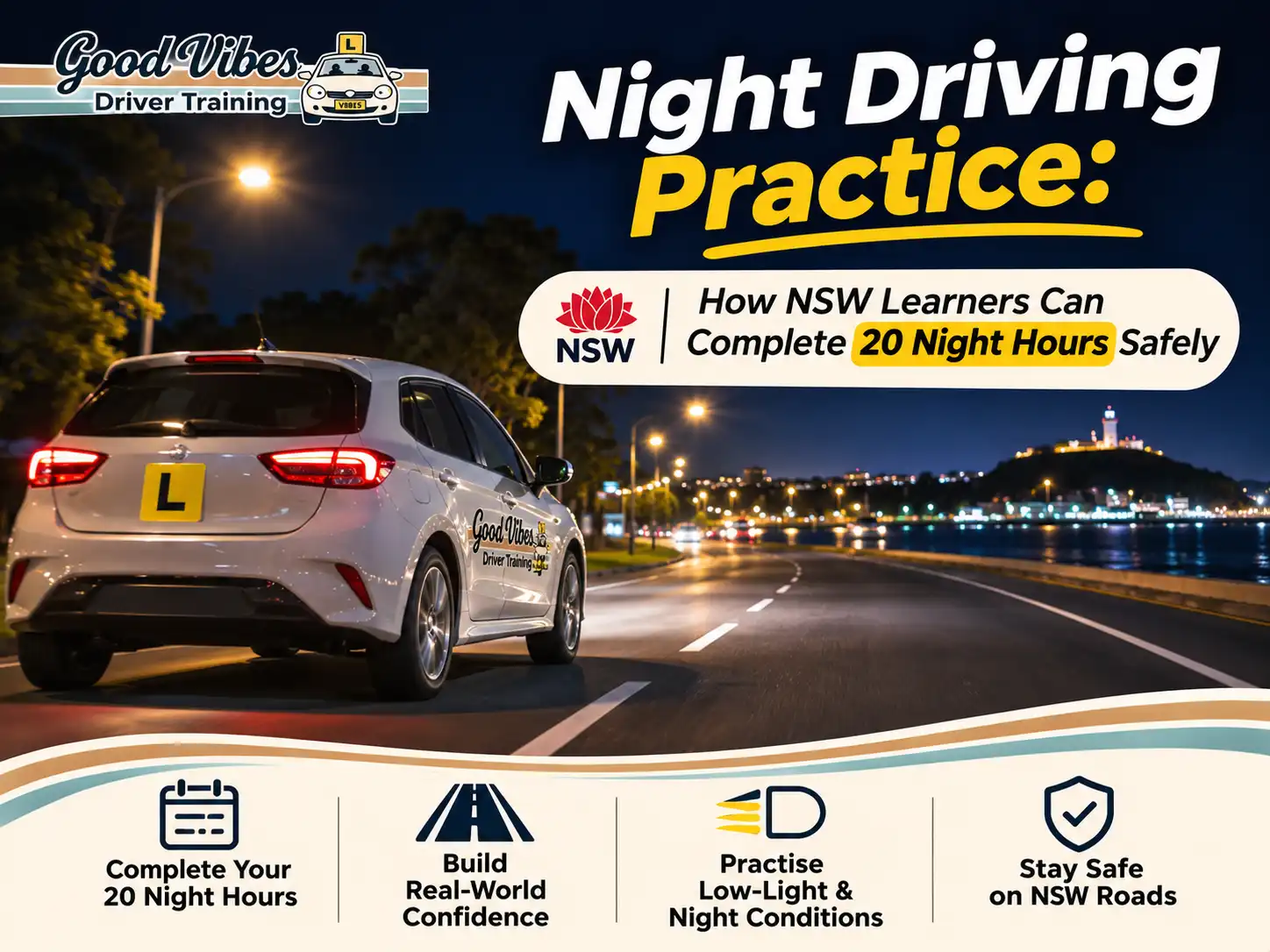
If you are under 25, you must log at least 120 hours of supervised driving, including at least 20 hours of night driving between sunset and sunrise. See using your learner driver log book.
- Night hours must be driven between sunset and sunrise.
- Bonus hours from a night lesson with a driving instructor do not count towards your night hours. They count only as daytime hours.
- Night hours must be real supervised driving with your supervisor beside you, just like daytime hours.
- Learners must complete these requirements before taking the driving test, unless exempt.
In practice, that means most night hours come from drives with a parent or supervisor. A night lesson with an instructor is still valuable for learning the skills, but it will not reduce the 20 hours.
How do you plan 20 night hours?
Twenty hours is about 40 half-hour drives, or 20 one-hour drives. Leave it to the last two months and it becomes a stressful scramble. Spread it out and it is easy.
- Start night driving once you are confident in daylight on the same roads, usually within the first few months.
- Aim for one or two short night drives a week.
- Use winter, when it gets dark earlier, to log night hours on ordinary trips home from school, sport or work.
- Begin on well-lit streets you know, then move to darker roads.
- Add variety: rain at night, busier roads, and longer trips when you are ready.
- Log each drive the same day, including the times, so it is clear the drive was after sunset.
What are the NSW rules for headlights and high beam?
From the NSW Government page on lights and horns:
- Your headlights must be on between sunset and sunrise, and at any other time when there is not enough daylight to see a person wearing dark clothing at 100m.
- You can use high beam if you need to see further ahead, even where there are street lights.
- You must dip to low beam when a vehicle coming towards you is within 200m, and when you are driving 200m or less behind another vehicle.
- Fog lights may only be used in fog or rain, or when other conditions limit your vision, and must be switched off once you can see clearly.
How do you deal with glare?
Glare from oncoming headlights is one of the hardest parts of night driving for new drivers. The NSW Government advises avoiding looking straight at the headlights of oncoming vehicles. If you are dazzled, look to the left side of the road and drive to the left of your lane. Slow down or stop out of the line of traffic until your eyes recover.
- Keep the windscreen clean inside and out. Smears scatter light.
- Adjust your interior mirror to its night setting, if it has one, to reduce glare from behind.
- Turn the dashboard brightness down so your eyes stay adjusted to the dark.
- If you wear glasses, keep them clean and talk to your optometrist about night driving.
Why is fatigue a bigger risk at night?
The NSW Government says research shows being awake for about 17 hours has a similar effect on your driving as a blood alcohol concentration of 0.05, and that fatigue-related crashes are twice as likely to be fatal. See fatigue. A learner who starts the day at 7am has been awake for 17 hours by midnight.
Warning signs include yawning, heavy eyes, drifting in the lane and head snapping. If they appear, park somewhere safe and take a break. The NSW Government says a nap of about 20 minutes works best. Supervisors need to watch for fatigue in themselves too.
What other hazards are worse at night?
- Pedestrians and cyclists in dark clothing, especially near pubs, restaurants and the foreshore on weekends.
- Drivers who are tired, distracted or affected by alcohol or drugs.
- Wildlife. WIRES says many native animals are most active at dawn, dusk and night. Slow down near bushland and avoid sudden swerving: brake firmly and safely instead. See WIRES' driver awareness advice.
- Roadworks, which are often done at night on main roads.
- Speed. Your stopping distance does not change at night, but the distance you can see does. Drive so you can stop within the area lit by your headlights.
A night driving progression for Lake Macquarie and Newcastle
| Stage | Where to practise | Skills |
|---|---|---|
| 1 | Well-lit local streets you know from daytime | Headlight use, judging speed in the dark |
| 2 | Main roads with steady traffic | Glare, dipping high beam, lane position |
| 3 | Darker suburban and semi-rural roads around the lake | High beam use, wildlife scanning, bends |
| 4 | Night rain and longer trips | Slower speeds, bigger gaps, fatigue management |
What if something goes wrong on a night drive?
- If the car develops a problem, turn on your hazard lights, steer off the road somewhere safe and well away from traffic, and stop.
- Get out on the side away from traffic if you need to leave the car, and stand well clear of the road.
- Call for roadside assistance, or 000 if anyone is hurt or in danger.
- If you hit an animal, make yourselves safe first, then call WIRES on 1300 094 737 or a nearby vet for advice.
- Keep a torch, a charged phone and a warm layer in the car for night trips.
Night driving rules once you get your P plates
Night driving does not stop being a challenge when the supervisor leaves the passenger seat. On your red P plates in NSW, under the P1 licence rules:
- you must not drive above 90 km/h
- you must not use any mobile phone while driving, including hands-free and loudspeaker
- you must have zero alcohol in your system
- if you are under 25, you must not drive with more than one passenger under 21 between 11pm and 5am, unless you have an exemption.
That late night passenger rule exists because crashes involving young drivers carrying groups of friends at night are a known risk. The night hours you log as a learner are your preparation for this.
How can supervisors help at night?
- Stay quiet and calm. Night is not the time for long explanations.
- Call out hazards early: a pedestrian at the crossing, a car waiting to pull out.
- Remind the learner about dipping high beam until it becomes automatic.
- Watch the learner for tiredness and end the drive early if needed.
- Keep your own phone away and your eyes on the road.
Brian's night driving tips
- Start night driving early in your learner period, not in the last two months.
- Begin on familiar, well-lit streets.
- Dip your lights within 200m of other vehicles.
- Look to the left edge of the road if you are dazzled.
- Stop the drive if either of you is tired.
Frequently asked questions
How many night hours do NSW learners need?
Learners under 25 need at least 20 hours of night driving, between sunset and sunrise, as part of their 120 hours.
Do night driving lessons count as night hours?
The lesson time can be logged, but the 3 for 1 bonus hours from a night lesson count only as daytime hours, not towards your night hours.
When must I dip my high beam in NSW?
When a vehicle coming towards you is within 200m, and when you are 200m or less behind another vehicle.
What should I do if I am dazzled by headlights?
Look to the left side of the road, drive to the left of your lane, and slow down or stop out of the line of traffic until your eyes recover.
Can I log night hours on the way home from sport or work?
Yes, as long as you drive between sunset and sunrise with your supervisor beside you, and record the drive accurately. Everyday trips in winter are an easy way to build night hours.
When should I start night driving as a learner?
Once you are confident on the same roads in daylight. Starting early lets you spread the 20 hours across your learner period.
Can P1 drivers carry passengers at night in NSW?
If you are under 25 and on red Ps, you must not drive with more than one passenger under 21 between 11pm and 5am, unless you have an exemption.
What if I feel tired during a night drive?
Park somewhere safe and take a break or swap drivers. The NSW Government says a nap of about 20 minutes works best.
Government references
This blog is for general information only. Always refer to NSW Government road safety resources for the most current rules.