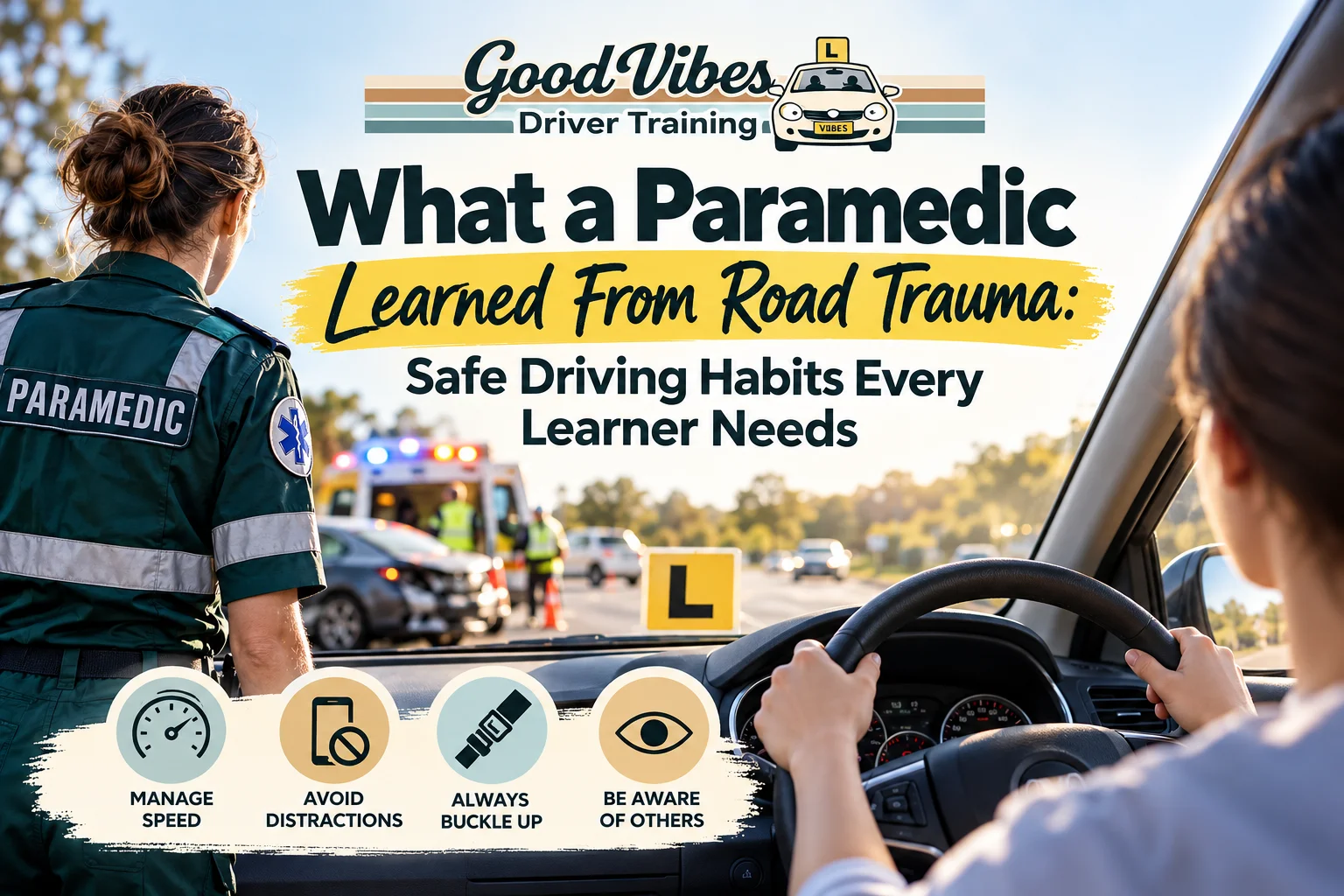

For nearly 20 years as a paramedic, I arrived at crashes after the decisions had already been made. A following distance that was too short. A glance at a phone. A drive home that should have been a nap. Most of what I saw did not come from bad luck. It came from habits. That is why I teach learners the safe driving habits I wish every driver I treated had been taught first.
Key takeaways
- Space is your best safety feature. Keep at least a three second gap in good conditions.
- Drive to the conditions. The speed limit is a maximum, not a target.
- NSW learners must not use any phone while driving, including hands-free.
- Being awake for about 17 hours affects driving like a BAC of 0.05.
- If you are involved in a crash, stop, help, and call 000 if anyone is injured.
This is not a scare piece. It is the practical list of habits I build into every lesson across Lake Macquarie and Newcastle, with the NSW rules that sit behind them. You can read more about my background on the about page.
Habit 1: Keep a safety cushion around your car
The single most protective habit is space. A gap in front gives you time to react. A gap beside you gives you an escape route. A gap behind is harder to control, but you can manage it by braking early and smoothly.
- Leave at least a three second gap to the vehicle ahead in good conditions, and more in rain, at night or behind trucks.
- When you stop in traffic, leave enough room to see the rear tyres of the car ahead touching the road.
- Avoid driving alongside other vehicles for long periods. Drop back or move ahead.
Habit 2: Drive to the conditions, not just the sign
The speed limit is a maximum. Rain, glare, darkness, school zones, roadworks and heavy traffic all call for less. Speed changes everything about a crash: how far you travel before you react, how far you need to stop, and how much force is involved if you cannot.
Habit 3: Put the phone away completely
NSW learners must not use any mobile phone while driving, or while stopped but not parked, and that includes hands-free and loudspeaker. See the learner driver licence rules. NSW Government advice for learners and P platers is to put the phone on silent, out of reach, or switch it off. See driving distractions.
Make it automatic. The phone goes in the glovebox or the back seat before the engine starts, every time.
Habit 4: Never drive tired
The NSW Government says being awake for about 17 hours affects your driving similarly to a blood alcohol concentration of 0.05, and that fatigue-related crashes are twice as likely to be fatal. See fatigue. If you feel the warning signs, such as yawning, heavy eyes or drifting in your lane, stop and rest. A 20 minute nap is the best fix.
Habit 5: Zero alcohol, zero drugs
Learner, P1 and P2 drivers in NSW must have a zero blood alcohol concentration, and it is an offence for any driver to have illegal drugs present in their system. See alcohol, drugs and medicines. Plan your transport before you go out, not at the end of the night.
Habit 6: Seatbelts on, every seat, every trip
It takes two seconds and works every time. As the driver, check your passengers are buckled before you move off.
Habit 7: Know what to do if you are first at a crash
NSW law requires anyone involved in a crash to stop and give as much help as possible. If anyone is injured, call triple zero (000) for an ambulance and then police. Turn off your ignition and turn on your hazard lights. See crashes. If you stop to help at someone else's crash, park safely well clear of traffic and only approach if it is safe.
How do professional lessons count toward your NSW log book?
In NSW, if you are under 25 you must log at least 120 hours of supervised driving, including at least 20 at night. One hour with a licensed driving instructor is recorded as three hours, capped at 10 actual hours, which adds 20 bonus hours. See using your learner driver log book.
Real situations Newcastle and Lake Macquarie learners face
Tailgated by the car behind
Do not speed up. Increase the gap in front of you instead, so you can brake gently and early if you need to. If the driver stays close, let them pass when it is safe.
A phone buzzing during a lesson
Ignore it. It is in the glovebox for a reason. Nothing on that screen is worth the risk, and as a learner you are not allowed to touch it anyway.
Driving home tired after school and sport
Tell your supervisor and swap, or wait. Tired learners make more mistakes, and good habits start with honest decisions.
Coming across a crash
Slow down, stay calm and only stop if it is safe. Call 000 if anyone is hurt. Never stop in a live traffic lane to look.
Common mistakes I see in new drivers
- Following too closely in moving traffic.
- Speeding up to close gaps instead of keeping a cushion.
- Keeping the phone within reach.
- Driving tired because the trip is short.
- Panicking when something goes wrong instead of slowing down first.
Penalties and demerit points
NSW learners and P1 drivers have only 4 demerit points, and P2 drivers 7. Fine amounts are not listed here because they change. See how demerit points work and Service NSW for current details.
Why habits matter more than reflexes
New drivers often believe quick reflexes will save them. In my experience, reflexes rarely decide the outcome. What decides it is what happened in the seconds before: the gap that was or was not there, the speed that was or was not right for the conditions, and whether the driver was looking at the road. Good habits create time, and time is what lets an ordinary driver avoid a crash.
A weekly habit plan for learners
| Week | Habit to focus on | How to practise |
|---|---|---|
| 1 | Following distance | Count three seconds behind the car ahead on every drive. |
| 2 | Scanning | Say aloud what you see ahead, beside and behind every few seconds. |
| 3 | Speed for conditions | Drive a familiar route in rain or at dusk and notice how your speed changes. |
| 4 | Phone-free routine | Phone in the glovebox before the engine starts, every time. |
| 5 | Calm recovery | Practise pulling over safely and resetting after a mistake. |
Staying calm when things go wrong
Paramedics are trained to slow down mentally when everything speeds up. The same applies behind the wheel. If something goes wrong, the first move is almost always to ease off and create space, not to swerve or brake in a panic. Breathe, slow the car, then decide. That is why my lessons are calm: learners who are relaxed think more clearly.
If anxiety is part of your learning journey, see how calm driving lessons reduce anxiety.
Habits for different conditions around Newcastle and Lake Macquarie
- Rain: slow down, turn on your headlights and double your following distance. Roads are most slippery in the first rain after a dry spell.
- Night: dip your high beam early for oncoming traffic, and slow down so you can stop within what you can see.
- Beach and holiday traffic: expect pedestrians, cyclists and drivers looking for parks rather than at the road.
- School zones: slow down and watch for children who may run out without looking.
- Freeway driving: hold a steady speed, keep left unless overtaking, and plan exits early.
The Safer Drivers Course
For learners under 25, the Safer Drivers Course builds hazard awareness and safe decision-making, and contributes 20 logbook hours toward the 120 hour requirement. It is a good complement to lessons, because it focuses on the judgement side of driving. For more on the learning journey, see from L plates to confidence.
Tips from Brian
- Space is your best safety feature. Protect it.
- Slow is smooth, and smooth is safe.
- Decide your phone rule before you get in the car.
- Sleep is part of your driving preparation.
- If nerves are holding you back, read how calm driving lessons reduce anxiety.
Frequently asked questions
What is a safety cushion in driving?
The space you keep around your car, especially in front. It gives you time to react and room to escape if something goes wrong.
Can learner drivers use a phone on hands-free in NSW?
No. NSW learners must not use any mobile phone while driving or while stopped but not parked, including hands-free and loudspeaker.
Is tiredness really as dangerous as alcohol?
The NSW Government says being awake for about 17 hours affects driving similarly to a BAC of 0.05, and fatigue-related crashes are twice as likely to be fatal.
What should I do if I am involved in a crash in NSW?
Stop and give as much help as possible. Call 000 if anyone is injured, turn off your ignition, turn on your hazard lights, and exchange details.
Do instructor lessons count toward the NSW log book?
Yes. One hour with a licensed driving instructor counts as three hours, capped at 10 actual hours, adding 20 bonus hours.
What is the most important safe driving habit?
Keeping space around your car, especially in front. It gives you time to react to almost anything.
Can P platers use a phone in NSW?
NSW advice for learner, P1 and P2 drivers is to put the phone on silent, out of reach, or switch it off. Check the current rules for your licence stage on the NSW Government website.
Why did a paramedic become a driving instructor?
After years responding to road trauma, Brian chose to help prevent crashes by teaching calm, safety-focused driving from the start.
Government references
This blog is for general information only. Always refer to NSW Government road safety resources for the most current rules.